


Where Heritage Meets Play: Inside Asia Civilization Museum's Let's Play! Exhibition

Updated: Dec 22, 2025
Asia has inspired some of the world’s most iconic board games, and the Asian Civilisations Museum is celebrating that legacy with a special exhibition until 7 June. Discover ancient games, rare artefacts, and how tabletop play has evolved over thousands of years. We speak with the ACM team for an inside look at this remarkable showcase.

Response by Noorashikin Zulkifli, Deputy Director, Curatorial, Education & Interpretation & Principal Curator, Islamic Art & Peranakan, ACM
Q: Could you briefly introduce the Asian Civilisations Museum (ACM) and share what the Let’s Play! exhibition is all about?
ACM explores Asia’s art and history through the lens of Singapore as a cosmopolitan port city, where cultures, trade, and ideas have long intersected. As the only museum in the region with a pan-Asian focus, we highlight the rich artistic heritage of Asian cultures and their global connections, while making these stories engaging and meaningful for audiences today. Through our collections and exhibitions, we aim to show how Asia’s heritage has always been in dialogue with the wider world.
Let’s Play! The Art and Design of Asian Games is ACM’s first “playable” exhibition, and also our first major exhibition dedicated to the world of Asian boardgames. It brings together over 150 works, ranging from games that originate from early civilisations to contemporary innovations that reveal the enduring significance of games in our culture today. More than a form of entertainment, games are a universal, wholly human activity that form part of our individual and shared heritage. Boardgames have been used to teach strategy, convey moral lessons, strengthen community bonds, and even reflect ideas of chance, fate, and the divine.
In the galleries, visitors will encounter exquisite works that reveal the intricate craftsmanship such as finely carved chess pieces from all over Asia (Japan, China, Thailand and Myanmar, to name a few) and congkak boards from Southeast Asia, alongside examples of games like chaupar, weiqi, xiangqi, shogi, mahjong, congkak and more that continue to be played today. At the same time, the exhibition highlights the creative ingenuity of contemporary designers in Asia who take inspiration from games and their local environment to make gaming objects and furniture. While the exhibition looks mostly at historical board games, we also recognise the burgeoning scene of modern boardgame design in our coda section as well as the Play Kiosk where visitors can try their hand at a slew of historical or contemporary Asian boardgames (for free!).
Q: What inspired the concept of Let’s Play! and why did you choose to focus on Asian games? With so many diverse games across Asia, how did you select which games to include in the exhibition?
As this exhibition is our offering to commemorate SG60, we thought about how we wanted an exhibition that could have wide appeal and highlight how connected we are, not just to one another here in Singapore, but also linking us up to the wider region and even global communities. Boardgames was that wonderful subject we landed on that had enough history, breadth and depth as well as beautiful, cleverly designed and masterly crafted objects.
One of our main inspirations are the communal tables and chairs/benches we regularly encounter or pass by in our daily lives. For me, at least, it was the first thing that came to mind – how some of these tables had chess or checkers or xiangqi boards incorporated into the design. It was something familiar and yet probably overlooked or somewhere in the farthest corner of our minds. That really came into focus with Jonathan Tan’s photo series, Lepak Downstairs, where he had taken clean, overhead shots of these tables – a simple change in perspective that drew your attention to the design of these tables. Which is why selected photographs from this series are featured in our lobby as a preamble to the show. This idea of looking at something anew was a motivating factor. I wager that everyone has at least had the experience of playing a board or card game, and through this exhibition, we would recognise that some old favourites are modern versions of ancient games. For example, Ludo could be attributed to the game of chaupar which originated in India.
By drawing attention to Asian boardgames, we wanted to spotlight both the diversity and universality of play across the region. Games such as congkak, go, xiangqi, or chaupar are deeply rooted in their cultural contexts, but they also travelled widely, adapting to new settings, materials, and communities. A congkak board in Penang might look different from one in Java, while chess, which began as chaturanga in India, evolved into numerous forms across Asia and beyond. These journeys tell a story of invention, adaptation, and exchange that resonates with ACM’s broader mission of connecting its visitors with diverse cultures.

The curatorial selection considered several key factors: cultural and historical significance, the stories that individual games could convey, artistic or design quality, and the diversity of play types, including strategy, skill, chance, and games practices by communities across the region. The exhibition aims to balance familiar examples with lesser-known ones. While games such as mahjong and weiqi are widely recognised, others like Snakes and Ladders trace their origins to gyan chaupar in India, where the game carried spiritual and moral associations.
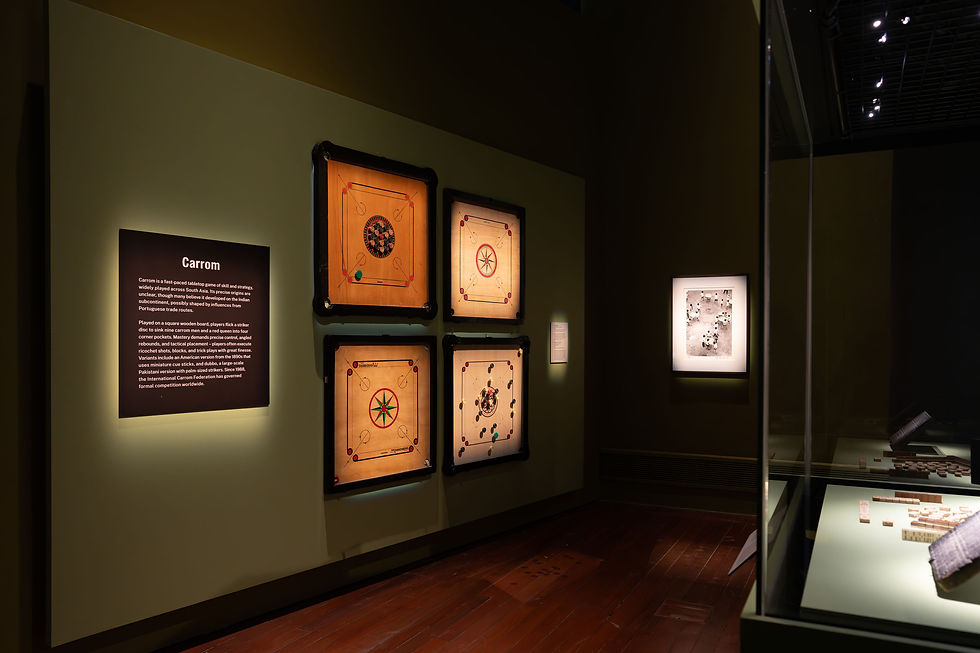
Partnerships with local gaming associations and schools further enriched presentations at the exhibition. Loans such as carrom boards used in school grounds by students, and the championship board from the 73rd Ōza Championship held in Singapore this year, a loan facilitated by the Singapore Shogi Group, a branch of the Japan Shogi Association, , opened up ways to explore how these games connect to histories, while retaining their relevance in contemporary society, and expand understanding of how games are practiced today.
Q: Could you share a memorable moment or story from the curation process that shaped how Let’s Play! came together?
I have many stories so it’s hard to choose just one. I was in Kelantan earlier this year and was looking to track down artisans who still carried on the woodcarving tradition. Kelantan has some of the finest and elaborate examples of Malay woodcarving. I was fortunate enough to visit a workshop belonging to Abdul Rahman bin Yusoff. And the first thing I laid my eyes on was this enormous congkak board in the form of a mythical bird known as burung petala indera, which the museum eventually acquired. Abdul Rahman shared that he had made a ‘family’ of three boards and had already sold the two smaller ones. When I asked where the two smaller boards had gone, he mentioned that one had gone to a professor in Singapore. My instinct lit up like a Christmas tree and I immediately asked if it was this particular professor, who happened to be a friend and colleague. Sure enough, it turned out to be him and I was absolutely delighted that I had the opportunity to request to borrow the smaller version for the exhibition, hence we could display at least two thirds of the family. Given that the ACM collection usually comprises historically made objects, I really treasure the opportunity of meeting with an artisan who is keeping the tradition alive, and that he had produced such a fine and ornate object that was so fitting for both this exhibition and to be part of the museum’s collection.
Q: How did you decide the layout or flow of the exhibition? Is there a narrative or emotional journey that visitors are meant to experience as they move through the space? What was the thinking behind making some sections interactive and others more observational?
As part of our research process, we look up past exhibitions to review how other museums might have approached the subject of board games, and noted that such exhibitions (though not as many, and far between) tended towards technical or ontological approaches. Our goal was to make the exhibition as appealing as possible to all sorts of visitors from different backgrounds, ages and so on. After much brainstorming and discussion, we went for a more evocative, emotive approach, and adopted the lens of the human condition.
The exhibition is laid out in five thematic sections. It begins with the primary question – why do we even play, considering that play is not a biological necessity the way food and water are. Through the intro section, we highlight three key ideas – the invention and playing of boardgames have long histories, games can embody the best of art and design, and games are a significant part of our cultural heritage.

From the why, we explore the sheer thrill we pursue in playing games, which can either lead to divination and spiritual achievement or to more detrimental effect. Then we look at how some boardgames are held in such high esteem because it cultivates both mind and character, before turning our attention to the social dimension of games and how they bring people together. The exhibition ends by contemplating how board games have always represented that frontier for breakthrough developments of AI – an inescapable fact of our lives today.
One notion that was clear from the onset was to ensure that this is a “playable” exhibition. We wanted to convey not just the history of games, but the overall aesthetic experience of games beyond the objects. Hence, it was important for us to incorporate opportunities for visitors to sit down and play as well as incorporating a soundscape at strategic points that would highlight the sounds of playing – for example, when players dip their hands into the containers and rustle through the weiqi stones. Specific displays are designed to encourage visitors to slow down to the details found in the artistry, design, and cultural narratives embodied in objects such as carved congkak boards or figural chess sets. Other sections are interactive, encouraging visitors to learn through participation. For instance, playable installations invite visitors to experience the mechanics of games firsthand, including matches against AI-assisted versions of chess and weiqi, loaned by community partners Singapore Weiqi Association and Singapore Chess Federation. These curatorial considerations open up different ways of understanding and appreciating games, drawing intrigue and curiosity towards their stories that span across the region.

Q: What were some of the biggest challenges in putting together this exhibition? Were there any difficult trade-offs or surprises along the way?
The primary challenge was on deciding what games to include. The incredible range of games that various cultures have invented over time made it very difficult to whittle down. Our selection was guided by what we already had in the National Collection, what we could perhaps source from lenders, what games are more widely played, the finite space of the gallery, and other factors. The extraordinary diversity of material required intentionality and careful consideration of the games we wanted to share about through Let’s Play!. The exhibition brings together over 150 works that span centuries, geographies, and cultural contexts across Asia. Curating such a wide-ranging collection meant moving beyond simply assembling notable examples to shaping a narrative that could make sense of their connections. Each object was selected not only for what it represents in its own time and place, but also for how it converses with others in the exhibition, revealing shared motifs, divergent practices, or unexpected continuities in the way societies have approached play. The process involved balancing recognisable icons with lesser-known artefacts, and arranging them in ways that would allow visitors to trace both the universality of games and their unique local expressions.

Q: How do you imagine visitors will think or feel differently after this exhibition? What kind of impact do you hope it leaves behind?
Ironically, I hope that visitors will walk away, thinking that games are not just a matter of play, and play isn’t necessarily frivolous. Games hold cultural significance revealing how people across Asia have thought, strategised, socialised, and expressed creativity over centuries. A game of go or congkak can be as revealing about a society’s values as a piece of literature or art.
At the same time, we want the exhibition to spark joy and connection. Games are accessible across ages and backgrounds. They invite participation, laughter, and sometimes friendly competition. If visitors depart not only with fresh insights but also with fond memories of playing together in the galleries, then the exhibition will have succeeded in creating experiences that are both meaningful and capture the spirit and essence of games in bringing people and communities together.

Q: What happens after the exhibition ends? Are there plans to maintain certain interactive elements or extend the program?
ACM is always looking for ways to extend the life of its exhibitions and bring them to broader audiences, whether through continued programming or travelling presentations. For now, the focus is on offering visitors a meaningful experience with Let’s Play!, while gathering feedback that will inform our future exhibitions and programmes on art, culture, heritage and design.
Response by Lum Jia Yi, Assistant Director (Audience, Communications, Digital), ACM
Q: What influenced the decision to have parts of Let’s Play! both indoors and outdoors? How do the different settings enhance visitors’ experience?
Play has always been inherently tactile—whether through cards, dice, or physical game pieces. However, in today's world, play extends beyond these traditional forms into immersive digital experiences. The inspiration behind blending both digital and physical elements in Let’s Play! stemmed from the desire to explore how play has evolved. In crafting this exhibition, we were conscious of different learning and playing styles, aiming to create a space that is accessible to a wide range of audiences. By incorporating both digital and physical experiences, indoors and outdoor experiences, we offer visitors a variety of ways to engage. Either through hands-on interaction, visual engagement, or digital immersion, ensuring everyone can find their own unique way to connect with the exhibition.
To reflect this, Let’s Play! expands into Let’s Play More!, with presentations such as the specially designed Game Board by Singapore illustrators 8EyedSpud, where visitors can design a token inspired by Asian games and see it animated on a digital screen within the museum. Similarly, Climbs & Slides by Forest & Whale reimagines Snakes and Ladders as a three-dimensional installation, where craft and design invite reflection on life’s uncertainties.

The activations also feature large-scale game boards of familiar games such as chess and ludo, as well as Play Kiosks!, which showcase both traditional games from the exhibition and new works by Singaporean game designers. Placing local creations alongside regional and historical examples reflects the continued relevance of games as both cultural expression and popular practice, while celebrating the ongoing innovation of today’s designers.
Games have also been played in varied settings: family homes, royal courts, village squares, and public streets. At Let’s Play More!, this versatility is reflected by extending the experience into both indoor museum spaces and outdoor spaces. For example, Checkmates! by Indonesian artist Vendy Methodos and Indian artist Osheen Siva features a life-sized board reinterpreting traditional chess with contemporary motifs. The installation animates the museum’s surroundings, transforming them into a communal space for spontaneous play.
This approach reflects the very dualities the exhibition explores: games as intimate yet public, reflective yet social, timeless yet continually evolving.
Q: Where can we find out more about this event?
Visit https://www.nhb.gov.sg/acm/whats-on/exhibitions/lets-play-2025 to learn more!


