Inside Teamwork Unlocked - From Private Google Workshops to Exciting Company Experiences

From building one of Singapore's largest private board game library at Google's office to creating engaging workshops for companies across the country, Brian Slattery, co-founder of Teamwork Unlocked, shares how he's turning play into a powerful tool for learning, collaboration, and workplace engagement.

Q: Please give the readers a short introduction about yourself and your company, Teamwork Unlocked. What is your “origin” story?
I’ve been living and working in Asia for my entire career. I was a Japanese and Marketing Major in university, so I moved to Japan shortly after graduating. Seven years later, I found myself in tech working for AMD, and I relocated to Australia for three years, then to Singapore 14 years ago, where I was their Asia Pacific consumer sales director. A few years later, I joined Google as the Head of Presales for Google Ads across Asia Pacific.
At Google, I was probably better known for my work outside of my core role. I was the head of Google culture for the Singapore office, which meant I was building tons of employee engagement and development activities across the office. In 2024, I tried something a bit unheard of. I was granted use of a large room and with a colleague, we built out a fully-functional escape room inside the office. We had magnetic locks, tons of cool mechanisms, lasers, you name it. Since it was an office activity, we created a workshop around it. In six months, we had 150 teams, over 800 people, go through it.
At the end of the year, I needed a change and decided to resign from Google. When I did, I got an email from a very senior Google leader, who encouraged me to start a company based on the escape room workshop, and even offered to invest if I did so. That kicked things off, and within 4 months of that email, my co-founder Tom and I had a company - Teamwork Unlocked!
Q. How did your love for board games start, and why did you decide to incorporate them into Teamwork Unlocked?
I’ve been surrounded by board games my whole life. As the youngest of four siblings, my house always had a great board game collection. I remember family game nights fondly - 1980’s party games were the rage then, so I remember lots of Pictionary, Balderdash, Trivial Pursuit, and Scattergories. I was lucky enough to have access to all of the great “ahead of their time” games from that period, like Fireball Island, Dark Tower, Thunder Road, Torpedo Run, and HeroQuest.
I shifted away from board games during university, but in 2013, my brother sent me a game in Singapore, and I fell back down the rabbit hole. Among gamers, my collection isn’t “oddly large”, at around 200 games total, but that’s crazy to the non-gamer. With that background, incorporating games into Teamwork Unlocked just seemed natural to me.
Q: Before starting Teamwork Unlocked, you worked at Google and created the company’s current board game library. Why did you decide to create one at that time?
My first big initiative for Google Singapore culture was creating a board game café after we moved to a new office. The old office was cozy, and everyone knew each other, but the new space was expansive. I wanted to create an environment where people could meet new colleagues safely and have fun. It was (and still is!) a great way for people from many different teams to meet and bond over some fun.
That went on to become the “world’s largest private board game cafe” with over 1,000 standing members at any point and over 400 games on the shelf. Not bad for a game cafe at a company!

Q: What do your courses that use tabletop games or physical games, like your escape rooms, aim to teach participants?
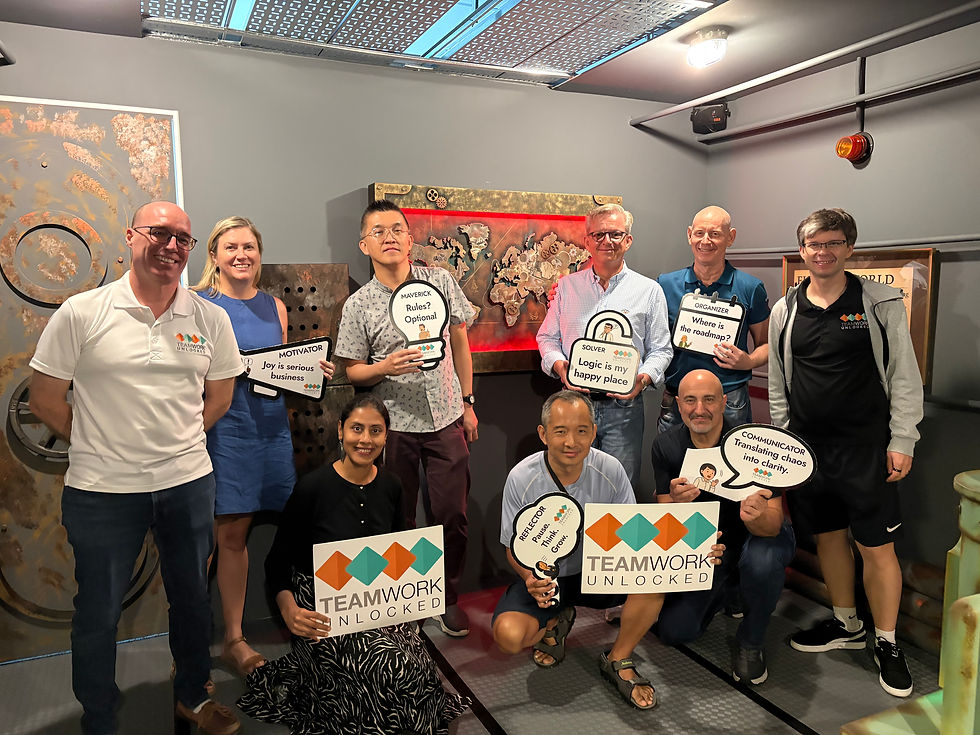
Each of our workshops starts with a learning objective in mind, we then work backwards from there to design the game portion. Our flagship workshop, Submerged, is a 4-hour workshop that uses a custom-designed escape room to teach our proprietary 9 Key Profiles of an Effective Team. Participants learn the roles needed for a team to function well, and we identify team gaps.
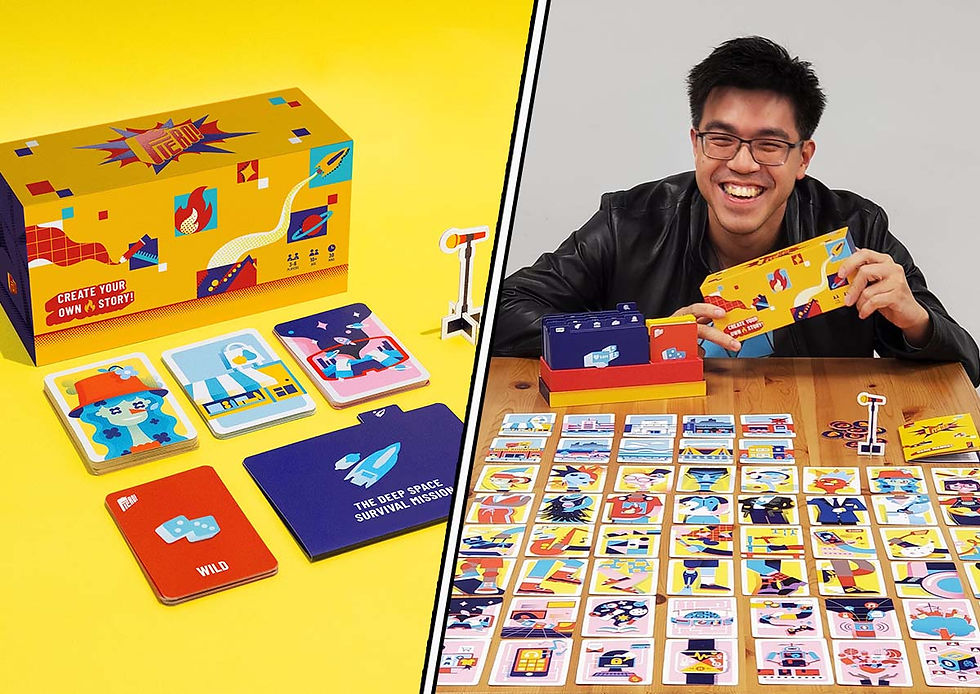
We use a series of logic puzzles to teach goal alignment in Eliminated. A horse-racing simulation shows how strategy and execution intertwine. We adapted a popular modern board game to illustrate career planning and used a modified version of the recent Singaporean Kickstarter success, Burnout, to show that burnout is a problem everyone in an organization must tackle.
Q: How did your experience at Google inspire the creation of Teamwork Unlocked?
The experiences my co-founder and I shared at Google unintentionally prototyped what we do now. More importantly, working there showed us how an open environment - full of play, experimentation, and freedom from judgement - can allow teams to have immense innovation and creativity.
I feel those types of experiences should be available to companies across Singapore. I believe that if we need to spend eight or more hours a day at work, why can’t we make it more enjoyable while we are there?
Q: As a relatively new incumbent to the training-based industry, how do you market yourself to potential clients?
Although we’re new to the training market, we bring a fresh, new, innovative concept to companies craving something different. Our credentials stem from decades of experience working in top corporate environments, and the game and puzzle design stems from a lifetime of experience in that world as my hobby. It’s a unique intersection, and that combination, along with the one-of-a-kind escape room hook, has attracted significant interest.
For marketing, we’re both ex-Google employees, so digital marketing comes naturally. I have also built a healthy following on LinkedIn by sharing my career experiences and learnings, along with my unique spin of gamification.

Q: How did you start incorporating the use of Artificial Intelligence in your courses while still keeping focus on your physical escape rooms and games?
As a two-person startup, we’ve heavily leveraged AI to ramp our business faster. My co-founder is the AI expert, not me. We joke that I’m in charge of all the “atoms” - the physical design of our workshops, facilitation and sales - while he handles the “1s and 0s”, meaning all digital aspects, including AI implementation and the company’s financials. It’s a good partnership.
We’ve used AI to generate some art for some of our workshops, which as a board game aficionado makes me cringe a bit. On the business side, we created our entire sales pipeline management system in-house using AI. We even partner with an AI-first company called UseKase to help us with some add-ons for our workshops
We are not planning to focus heavily on digital workshops. We want our workshops to remain primarily physical, maximizing face-to-face interaction. However, we do want to use AI to enhance our workshops. It’s great for rapidly summarizing multiple data points, helping us code interactive portions of the workshops, and even brainstorming. But we remain focused on human creativity first, with AI supplementing us.
Q: How do you think Artificial Intelligence will affect the tabletop board game industry?
There's so much talk on this topic already. Serious backlash has already occurred against companies looking to replace human artwork with AI art in games. Overall I think that's a great thing, we need to protect artists. Yet as the owner of a fledgling business, I can definitely see the temptation to use AI art.
I believe using AI to design games is still quite a way off, at least I hope so. AI won't understand what makes a game fun, or it will tend to overcomplicate things, or create unnatural combinations of mechanics. It might be useful for the math behind some game engines and for playtesting broken combinations. Those are potential highlights.
I can see the potential for AI to be heavily used in mass-market games, but for true hobbyists, I think we'll see the same kind of fierce protection of the industry that we see from movie and music lovers, who don't want their art forms taken over by AI.
Q: Would you ever consider making your own board game to use in one of your courses, or just for your personal fun?
We already have two workshops that utilize board game elements. Some game mechanisms can tie really well into corporate themes with a few tweaks. It's really important to try to separate what I think makes a good game from what makes a good foundation for a lesson, though. The vast majority of our customers know nothing about modern board games, so we need to be very careful with what we use, because most modern game mechanisms that are very familiar to hobby gamers are completely foreign to non-gamers.
I'm currently working on the early stages of a design which will use an "I cut, you choose" element and some other pieces, but it will not be a pure board game, it will just use some game elements to bring the rest of the workshop to life.
Q: What were some fun memories from your time working on Teamwork Unlocked?
It's only been a year and a half so far, so I think I'm still making more new memories than the ones behind me. Testing all the equipment for our escape room was great. The first time we ran each of our workshops for customers was very special. Plus, we have so many great customer stories. We hope they'll be a book someday!
Q: Are there any future plans for Teamwork Unlocked?
We've been rapidly innovating. We've launched four different programs in our first year of operations, have two more in development, and I seem to think up a new idea every few weeks. I tend to bounce from one new idea to the next, so it's my co-founder's job to keep me focused on only developing one or two projects at a time. For now, I'm finishing the two in development, but I can't wait to start working on some of my other new ideas.
Q: Where can we find out more about you and Teamwork Unlocked?
The easy one is for people to check out teamworkunlocked.com for information about all of our programs. If you'd like to hear more from me directly and to follow my wild and crazy stories, follow me on LinkedIn at www.linkedin.com/in/brianjslattery .