


Inside Jelly Jelly Games: Building a Global Tabletop Brand from a Café

What started as a board game café in Tokyo has become a gateway for Japanese games to reach the world. We explore Jelly Jelly Games’ small-box design, the realities of localization, and the challenges of bringing Japanese indie games to international players.
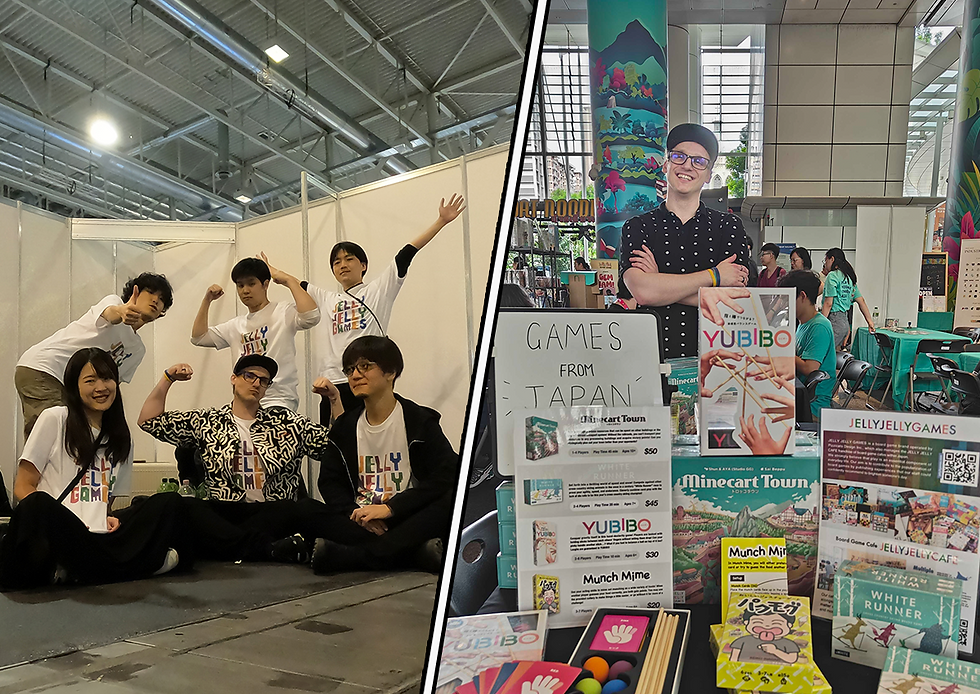
Q: Please give our readers a short introduction to yourself and your company. How did you come to join them?
Hi everyone! My name is Jacek Mackiewicz (pronounced roughly Yah-tseck - Polish names, I know…) and I am in charge of Global Development at Tokyo-based Pizzicato Design. We’re a board game company that operates the JELLY JELLY brand of cafés and stores in Japan, as well as the publishing, localizing, printing, and licensing of board games. Although I’ve only been working in the industry itself for a short time, I have loved board games since my university days. While my parents played the occasional game of Monopoly or Super Farmer with me growing up, it wasn’t until receiving a copy of Splendor from an online Secret Santa exchange that I truly fell in love with the hobby. Soon, we were having nightly play sessions with our housemates and friends, progressing to games like Betrayal at House on the Hill and Scythe. Since then, I have amassed quite a hearty collection across a wide range of genres, and I’m always on the lookout for new, exciting titles!
Play has always been an important aspect of my life, having worked in the video game industry for several years (and spending way too many hours on World of Warcraft). When I moved out of the UK and into Japan, it proved difficult to find a job in video games without Japanese language fluency. As I lived minutes away from a JELLY JELLY CAFE, I sent off a part-time staff application, intending to be summoned whenever foreign customers needed to be taught a board game.
While this strange idea of mine was rejected, I was invited to the head office for a chat, and I somehow broken-Japanesed my way into a part-time position, quickly transferring to full-time afterwards.
I now mainly introduce foreign games to Japan and help spread Japanese board games internationally, though I also tend to undertake any English-related tasks, too.
Q: Which moments in your journey with JELLY JELLY GAMES have been the most meaningful or rewarding, and what made them stand out?
I am very fortunate in having my JELLY JELLY GAMES journey filled with meaningful and rewarding experiences, making it difficult to choose just one or two. As an avid board game collector, it never stops feeling surreal to collaborate and work with people and teams whose work and designs built lasting memories with friends and family. However, two particular moments do stick out for me.
The first involves our 2024 cooperative dexterity title, YUBIBO. This was a game I originally underestimated, as it was so different from the traditional “board game” experience that I was used to. I was involved in the playtesting, translating, and even modelling for the cover — the upper-left hand belongs to me — but it wasn’t until I was demoing the game during its release at Spiel Essen 2024 that I truly understood the magic of the game. The premise is very simple - players draw a card that displays which finger they need to use to connect a stick to another player’s finger. Connect enough sticks for your player count, and you win!

Seeing the sheer joy, focus, chaos, and delight from players across all demographics was, and continues to be, a highlight of my job. This game physically brings players together and naturally fosters a collaborative spirit, with smiles and laughter that never quite get old. It’s a nice reminder about the importance of play in our daily lives.
While YUBIBO encapsulates the joy of sharing Japanese games internationally, my second favorite moment is about the inverse: bringing foreign games to Japan.
We recently released the Japanese edition of the 2-player card game Mindbug. Originally launched back in 2021 via a Kickstarter campaign (which I personally backed when I lived in the UK), I spent close to a year convincing the team that we should release this title in Japan. Having poured so much of my time, passion, and belief into this game, I was naturally quite hesitant before the release to the Japanese public. On the day of the Tokyo Game Market, where Mindbug was first available, I just nervously hoped that players would enjoy it.
I will never forget how many people - both colleagues and customers - thanked us, and me personally, for releasing the game due to how much they enjoyed it. All my worries were instantly squashed, and I was able to share in the buzz and excitement of the release with everyone else.
There’s one more personal thing I simply have to mention. I’m a huge fan of Junji Ito’s horror manga - I have a tattoo of his illustration on my left arm. Getting to do the translation for and signing of the first official Junji Ito card game to be part of our international store is a pinch-myself-to-know-I’m-not-dreaming accomplishment.
Q: How do player interactions and feedback influence the way you approach designing new games?
While I assist in both playtesting and feedback sessions, I am by no means involved in the game design process itself. From my prior video game development experience and through conversations with our designers, I can definitely confirm two core truths: game design is an iterative process, and it's important to start small and build upwards.
The iterative process part is key to all of this. Games constantly shift, evolve, and mature over the development process. One should never get too attached to an idea, as playtests, feedback, and number-crunching must take priority. Very few game mechanics ever end up in the same place as they started, with each play session being one step forward and two steps back. We’re constantly playtesting with different people to broaden the feedback we receive, and end up having to “break” stuff as we try out new things.

However, as quickly as possible, narrowing down on the core of a game that everything else revolves around is crucial. This is where the starting small comes in. The bigger ideas, interlinking systems, and gimmicks can come about naturally later.
Both of these aspects will become evident as test plays are performed. Whether with your colleagues, friends, or at a local café board gaming event, each player will offer some new perspective that will influence part of a game that you never considered before.
One repeating pattern I’ve noticed during our test plays is that I’ll often approach games from the UX perspective of an ex-video game developer. The design department will be caught off guard with icons or legibility improvements that they hadn’t previously considered. Likewise, the grammar of our card effects would be full of errors without the double-checking of a recent Master’s graduate. A fresh pair of eyes will usually lead to innovative solutions and improvements.
Q: How do you approach designing games that appeal to both casual players and more competitive or strategic audiences?
I think this is one of the things that Japanese games tend to do really well in general. Allow me to answer tangentially. Board games in Japan tend to do better when they come in smaller boxes. Limitations on both home storage space and disposable income are the main reasons for this. With limited storage space available at home and economic factors preventing lush, deluxe productions from finding an audience, a decrease in the size of your box increases the chance of ending up on someone’s shelf. Less space = fewer components; fewer components = being very conservative with what makes it into the final game, and removing any and all ‘bloat’.
Combined with the “kawaii” culture centered on approachability and friendliness, I think Japanese games tend to have low barriers to entry with simple rules whose true depth doesn’t become apparent until several plays later.
With this in mind, I believe a lot of games that we publish can be taught very quickly - going from learning to playing is usually a breeze, and it’s not until the game is over that you hear a player exclaiming “Ohhhh, I get it now, I know what I should have done differently”. With cute and colorful art, this is how we strive to design games that are simple enough to attract casual players, while offering enough replay value for competitive players to keep the titles in their rotation.
Q: JELLY JELLY GAMES operates across games, cafés, and events. How do these different elements work together to shape the overall tabletop gaming experience for players, and what kind of experiences or connections do you hope they take away?
We’re very lucky to be able to rely on intersections of the board game market to help guide our decision-making process. Originally, we started as a board game café only. A co-working space founded by Shirasaka-san, our CEO, provided customers with quick, accessible games to enjoy, including some that Shirasaka-san designed himself. Over time, this café would shift its focus entirely to board games, and we would use customers' play habits, opinions, and reviews to guide some of our publishing and expansion choices.
From the get-go, we wanted the cafés to provide opportunities for playing great games from all over the world, which we can’t do without engaging with and understanding the global board game scene. I spend a lot of my free time researching Board Game Geek (even before it was my job…), we talk to event attendees, we track games on social media, and we ask our players what their favorite games are and why. This really helps us set a direction for game publishing. Just this year, in 2025, we were able to obtain the perspectives of players from the UK, Singapore, the US, Taiwan, Japan, and Germany en masse via in-person events.

While one can always read about various cultures and approaches online, it’s completely different to actually experience them in person and be able to bring actionable insights back home.
As for the players, we simply hope that they enjoy our titles. We strive to be in a position where our games bring them joy, and they come back to our booth excited to see what’s new. We’re overjoyed to have heard this feedback at various events in 2025 – thank you to all who stopped by and shared your buzz with us!
Q: JELLY JELLY GAMES is one of the few Japanese publishers active in overseas conventions. What motivates you to participate internationally?
Aside from the joy of meeting new people, experiencing new cultures, seeing global trends, forming new partnerships, eating all kinds of interesting food, buying board games ourselves that we can’t easily get in Japan, and a whole slew of other reasons, our main goal is to help spread the culture of Japanese board games around the world! Lately, we aren’t only focused on our own published titles either. Halfway through 2025, we started dipping our toes into operating localization and licensing services for independent Japanese creators: JELLY JELLY INTERNATIONAL. These unique, quirky, and original titles are the result of sheer passion and dedication without financial backing from a publisher. We felt it would be a shame not to let players from all around the world experience at least some of these games, so we bring them with us to events, demo them to publishers, and translate the contents so that they can be enjoyed by a wider audience.
Both planned and chance meetings at expos led to many of our games being published internationally, and international games being published by us in Japan.
We also know that many publishers, players, and designers are fascinated by the Japanese market, but can often find it impenetrable. It’s our pleasure to help answer questions, provide feedback, advice, or assistance in any way that we can.
Sharing games and activities that brighten someone’s day is why we do what we do, and a big part of that is showing up in person.

Q: Expanding overseas can be both exciting and challenging. What are some of the cultural or logistical barriers you’ve encountered in bringing Japanese games to international audiences, and how have you learned to navigate them?
We’re always learning more about the cultural differences between various board gaming markets and players around the world. There are topics, themes, and art styles (to name a few) that work in certain regions, but not others.
Through my heritage, I have intimate knowledge of Poland’s cultural fascination with dark fantasy. From countless grimdark novels published every year that have their own section in each book shop, to the haunting artworks of Beksiński, works with this artwork and theme would not be suitable for the majority of Japanese players. Similarly, we’ve often been told that, despite the constantly rising popularity of Japanese culture, anime aesthetics simply don’t sell well in Europe.
The other issue we come across is the box sizes - I mentioned previously that space here is limited. We often ask international publishers if we can reduce the box size for a Japanese edition. We’ve had to turn down some excellent games for this very reason. On the flipside, Europe and the US have the opposite problem - smaller games don’t tend to do very well. This has proven to be a difficult problem for us, as we put a lot of effort into shrinking the sizes of our titles as much as possible. It’s almost a glass-half-empty/half-full problem.
If a box is big in Japan, the perception might be that the game is bloated and overcomplicated.
If a box is small in the west, the average player might think that the game is too simple and not worth the time investment/cost.
As we strive to publish multilingual editions of our games, this is a very tough balance for us to achieve.
Not all challenges can be planned for. Out of nowhere, sending goods to the US became an unknown. Costs were fluctuating, dates were in flux, and the industry went into a panic. Although we initially adjusted our pricing, Japan Post stopped sending parcels to the U.S., resulting in our halting of shipments. While the situation is proving too volatile for a current solution to be implemented on our side at the moment, we’re determined to share our games with players who simply want to enjoy them as soon as possible.

Q: Can you share some of the challenges you face in creating games that appeal to both Japanese and international players, and how you have overcome them?
I alluded to some of the artwork challenges we’ve faced in the previous question. Naturally, different countries and cultures have different preferences, likes, and dislikes. Not only do we want to appeal to potential customers, but we also need to be mindful not to deter or turn away players who would otherwise love the game systems too. We’re fortunate to have a wonderful design director in Kozu-san who can steer the direction of each JELLY JELLY published game. We are immensely proud to share the Japanese nature of our board games with the world, but naturally, we try to avoid tropes that could feel derivative. I think our 2024 card game FIXER is a fantastic example - though even in this scenario, we have been told that the art is too mature for some markets.

My pitch during development was orcs and elves in waistcoats, suits, and fancy dresses, but we definitely made the right call going with this striking political art direction instead.
Art aside, certain regions prefer various mechanics over others. For instance, there’s the generalisation of European games being “thinky games where you transport wood to make calculations” and American games that are “beer and pretzels games” focused more on experiencing fun at the table.
One thing I do want to stress, though, is that games are best when they come from the heart and the willingness of a designer to explore a certain mechanic, theme, or genre. I think a good game will always find an audience, and sacrificing vision to pursue broader appeal is rarely the right choice.
Q: What exciting projects or games are you currently working on that fans can look forward to?
There are lots of exciting projects that we are working on at the moment! Most of them I can’t share publicly just yet, but we’ve already announced some of the upcoming international titles we will be localizing into Japanese at the Winter Game Market 2025. Wilmot’s Warehouse, Naishi, Dustbiters, and Light Speed Arena will be making their way onto players’ tables throughout 2026!
In terms of new games from us, you can expect at least one cooperative adventure next year. We’ll also be adding a lot of independent titles to JELLY JELLY INTERNATIONAL, and supporting game designers with rule translations into English. Keep your eyes peeled on our website for updates!
Lastly, JELLY JELLY CAFE and JELLY JELLY STORE will keep expanding their physical locations. We’ve even started researching the possibility of expanding overseas, so please do get in touch if you’d like us to come to your city!
Q: For those interested in discovering your work, where can they learn more about your games and projects?
For news and updates on independent Japanese games in English, please subscribe to our www.jelly2intl.com newsletter - we’d love to see you there! We’ll keep expanding this website with articles, interviews, games, previews, and much more next year.
We’ve got Instagram profiles for all our cafés, game publishing, and stores. jelly2games for Japanese updates and jelly2intl for English ones.
Lastly, you can follow me personally on Twitter @PapaPolski, but I basically never tweet…!


