


Meet Dassie Atelier - The Couple Bringing Wonderous Joys To The Table
- Denise Chan

- Jul 29
- 9 min read
Updated: Jul 30
Inspired by their childhood memories of loving board games, Dassie Atelier was created to inspire the same connection, joy, and wonder that comes with each tabletop adventure. We speak to Vanessa and Nicholas Wong-Yong, founders of Dassie Atelier, as they share their backstories and experiences in the production of their board games.
Q1: Please give the readers a short introduction about yourself and your company. What is your “origin” story, and how did you come about creating games?
Hey there! We are Vanessa & Nicholas Wong-Yong, Co-founders of Dassie Atelier and also, you may have guessed it, a husband and wife team! We create beautifully crafted games that blend accessibility with depth, making each play a journey through culture and story! While we only went full-time into designing and publishing games last year, our journey getting here truly began when we were kids…
Vanessa: I grew up being exposed to games from a young age. My parents would get my siblings and me games that we could play together as a family - you’ve got your international classics such as Monopoly, Risk, Cluedo and Taboo; and regional classics like Snakes & Ladders, the Airplane game, Pickup Sticks and Five Stones! I fondly remember numerous hours spent together with my family, unintentionally learning lifelong lessons that come with play, whether it be strategizing your next move, negotiating with your competitors, or simply riding the wave of emotions from losing your first game. It was a simpler time, there weren’t that many games with over-the-top crazy ideas or out-of-this-world development budgets, but they brought so much joy nonetheless!
Nicholas: I have always played games in all forms. As a child, I played many video games and trading card games, then started getting into board gaming 15 years ago! Gaming has always been part of my life, and I love sharing my love of gaming with others, be it hosting board game nights or Thursday Night Magic. Eventually, I felt like I wanted to create something that I would be proud of to share and play with people. Bringing them the same joy that all these mediums of gaming brought me!
Two years ago, we sat down, stared at our board game shelf, and one thing that we realized was sorely missing were games designed by Asian designers! We believe that great games can be created by anyone, anywhere! That’s when we decided that it was a journey we wanted to embark on together, to bring the stories that are less told to the world, one game at a time, while working with creatives across the globe. And thus, Dassie Atelier was born!
Q2: Are you currently employed in a non-tabletop related career or are you publishing games full time? How do you manage your time with this project?
We are both running Dassie Atelier full-time! For most of our friends and family, it came as a surprise since it’s a completely new space for both of us. Coming from tech and innovation, a lot of what we were doing before are complete opposite of what we have now found constitutes running an indie publishing company!
A friend recently asked what our day-to-day running of the business looks like, and it was a tough one to answer, simply because no two days have looked the same! It sounds like a stereotypical answer, but stereotypes tend to have certain truths to them. One moment we’re running playtests, the next we’re designing print files (of which constitute non-existent graphic design skills that we’ve had to develop along the way. *P.S. Many thanks to our talented friends who have rendered us so much help!). Then there’s production, marketing, logistics, events, working with creatives, the list goes on...
That being said, we’ve also found so many parallels between the work we used to do and seek to apply them wherever relevant!
Q3: Please give a brief introduction about your flagship game. (Its premise, featured mechanics, etc)
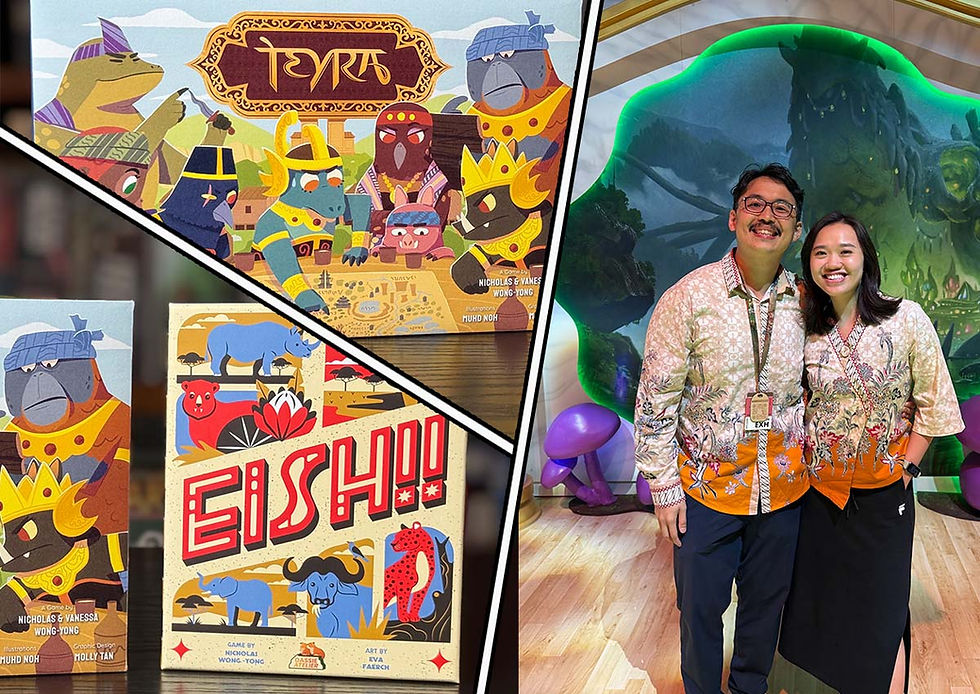
We currently have 2 games: TEYRA will be launching on Kickstarter soon, while EISH!! is currently available for purchase!
TEYRA is a competitive strategic card game set in a world inspired by Medieval South-East Asia. Players take on the role of Kinfolk Leaders and must skillfully deploy the efforts of their supporters as they advance their campaign across the land to spread influence, control areas, and gain prestige while keeping morale high. Some of the familiar mechanics that we have incorporated into TEYRA include Asian Blackjack rules, lane battling, hand management and variable powers that change the game.
In EISH!!, players are Rangers in training bringing tourists out into the bush to spot the Big 5. Come out on top as you skilfully AVOID spotting the same animals as the Lead Ranger while taking breaks to spot cute Dassies. However, be sure not to get caught skiving off together! Begin your trek into the bush in this game of probability, mind games, and light strategy! This light game introduces players to simultaneous action selection, watching opponents’ board state and strategising for future turns. EISH!! is actually inspired by the local childhood game of “JiKoPa”, which we have realised that only a very specific age group of Singaporeans would know.

Q4: What was the design process like for your game? Did it differ from the traditional game design process? If yes, why?
We can’t speak much to the traditional game design process, but what we employ is simply aligning on one core thing: The Why.
The vision for all our games, including TEYRA, EISH!!, and the ones that we have in prototype are for them to spark a little wonder in our players, so that each play feels like a journey. Whether long or short, we hope for our games to expose players to new experiences, ideas, and most importantly connection with fellow players!
With this vision in mind, the design process of our games may differ from one to another, especially as we both have very different creative processes and the focus of each game could vary. But since we are aligned on where the games need to land with each player once it’s out on the table, it keeps us focused while we’re deep in the trenches.
Taking TEYRA, for instance, the game that kick-started the journey for us! We wanted to solve a problem that we ourselves faced as gamers: being stuck between games too complex for our non-gamer friends and lighter games that just didn't excite us. So, we sought to create a light to medium game that would be easy to teach, but grows mechanically more interesting as you layer the different options, keeping people coming back for more.
That, as a core design philosophy for TEYRA, led us to introduce a very familiar mechanic: Blackjack! Most people we know have either heard of it or experienced playing it at some point, and our challenge was to put that into a game that could be exciting for gamers as well. We also had a couple of other boxes to tick as we wanted to take this opportunity to share more about our region and interesting cultural nuances without it becoming a history lesson, so we peppered asian blackjack rules in there, coupled with a theme that pointed to a time in Singapore’s history that is lesser known.
Tying the different facets together and ensuring that mechanics aligned with the story being played out, TEYRA became what it is today: designed to immerse players into a struggle of influence, politics, and keen tactics. Not to mention the kind of table talk that takes form, the forming of uneasy alliances in a pinch, or the ruthless betrayal you never saw coming, wahahaha… just the interaction we LOVE!
Q5: What challenges did you face when making the game, and what insights did you discover along the way?
The most challenging thing we’ve had to contend with is finding the right playtesters for each phase of game development. After numerous playtests, it's become clear to us that just because someone designs or plays games, it doesn’t naturally make them great playtesters. Stay with us here, we’ll explain why.
Everyone has preferences in the type of games they play, and naturally, a mechanic may evoke different feelings in different people. So if you’re creating a game for a certain target audience, you need to focus on feedback that applies to that audience, but most of the time it is hard for a player to separate these feelings unless your playtest session is properly framed and targeted.
After many playtests where we’ve both had long discussions post-session, we’ve learnt that not every piece of feedback is relevant and knowing how to pick out the gold is essential.
That insight doesn’t automatically make us better playtesters, but it helps us when we show up to playtest games for fellow designers around us. We try to let our personal opinions take a backseat and focus on what the designer intends for the game, then once we know what they need from us, we formulate our most useful and relevant feedback needed at that time!
Q6: What’s one piece of advice would you give other indie board game designers?
Well, if there’s anyone who is looking to enter the game design or publishing space, get ready for a wild ride and also if you think you’ve got your timeline down, add another 200-300% to that and more, then perhaps, just perhaps, you’ll be closer in your projections!
Before we kicked off our journey, we must admit that we were very optimistic about the timeline to get everything out, but it’s taken way longer than we originally planned. Physical products have never been something either of us have handled before, and thankfully, we were able to be flexible on the timeline creep, but it may not always be the case for everyone. One thing that we’ve realized is that things are not always within our control, especially when it comes to working with vendors, where our schedules need to then be synchronized to theirs!
Q7: Have you ever had a prototype or mechanic that completely failed in testing? How did you handle that?
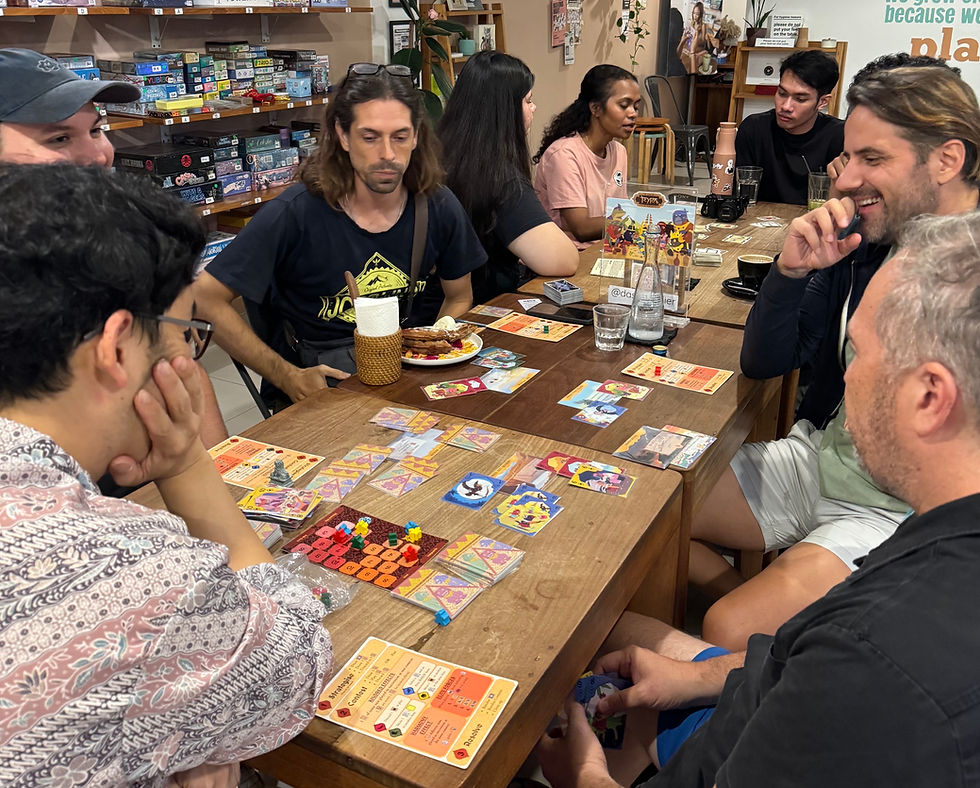
Initially, for TEYRA, each player has a hand of seven cards each round that they will use to try to win as many areas as possible. The intention was so that the players had to strategize and figure out how best to optimize their game plan with the cards that they were dealt.
However, in testing, we noticed that the challenge checked off the strategic box, but didn’t always feel good to players... So we went back to the drawing board to test different ways of introducing agency to this phase and eventually landed on a simple shift of a “Draw 1, Play 1 and Discard 1” mechanic where players had chances to cycle the cards in their hand they did not want and potentially get cards that they would find useful.
The interesting thing about this process is that the fix was really simple! But the more interesting thing about the process was testing the different options to see how people responded to each version. We know that a core driver for the development of our games is the human experience and the kind of emotions we want a player to feel. Designing that human experience is where we’ve been able to draw on some of our prior work to find a fix that achieves our goal.
Q8: What’s a piece of feedback from a playtester that was hard to hear but ultimately made the game better?
In an early version of TEYRA, we received feedback that winning certain areas did not feel rewarding, as it only had a Morale tracker at that point (Teyra’s version of Health points). Victory in some areas did not build progress on that front and instead awarded different benefits. Our original intention was to give players tough choices with a variety of areas where some provided for tougher terrain, but were more valuable than others. It was only in testing that we realized that, emotionally, players may see those areas simply as second-tier options rather than a true struggle between equally enticing choices. Now, we definitely didn’t want that…
This was a trickier one to fix because it WAS the game at the time, but it led us to reimagining the game system, thus introducing our Prestige tracker (widely known as Victory Points), where every area card in the game now feels rewarding to compete for and progresses the game.
Q9: Was there a skill or resource you realised you didn’t have when you started, and how did you address that gap?
We briefly mentioned before how the world of physical products is really different from what we were previously used to. Things that we normally took for granted in our daily lives, such as mandatory testing on goods and import/export processes, now give us a new appreciation for the legends working behind the scenes to stock even the simplest product on our shelves.
Looking back on our journey so far, there are so many things that we would’ve struggled with just a year ago that we now at least have a few answers for. Some of it we had to learn the hard way, and for others, we were lucky to befriend a solid group of game designers and publishers here in Singapore who readily shared their experiences with us!
For two people who came into this wondering where all the Asian game designers were hiding, we’ve been so grateful to have met so many of them and made amazing friends along the way! We’re so glad to be a part of the growing community of regional game designers!

Q19: Where can we find out more about your games?
You can find out more about our games on our website, follow our socials @dassieatelier and check out TEYRA’s Kickstarter preview page here!


